
The Kentucky Cave Wars / Floyd Collins
How roadside rivalry, tourism, and one trapped explorer turned Sand Cave into a national obsession
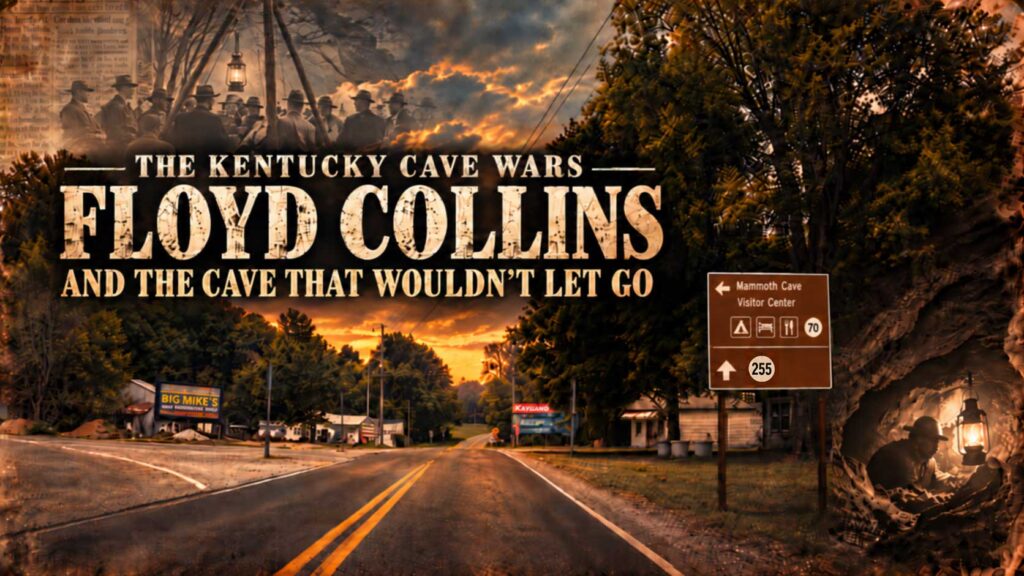
The Kentucky Cave Wars: Floyd Collins and the Cave That Wouldn’t Let Go
In the early twentieth century, Kentucky cave tourism was not a genteel little business.
It was cutthroat.
Cave owners fought over road signs, tourists, underground property lines, and access to the growing stream of motorists heading toward Mammoth Cave. Competitors hired roadside cappers, tore down one another’s signs, traded accusations of sabotage, and eventually ended up in court over who owned passages hundreds of feet beneath the surface.
In at least one case, the rivalry turned deadly.
This was the world Floyd Collins knew.
Collins had already discovered Great Crystal Cave in 1917, but the cave’s location left him at a commercial disadvantage. Other attractions sat closer to the roads carrying tourists toward Mammoth Cave, and Floyd needed something better positioned to capture that traffic.
That search led him to Sand Cave.
By January 1925, Floyd had been working there for weeks, clearing passages, using dynamite to remove obstructions, and trying to dry the cave with fires near the entrance. On January 30, he crawled inside again.
He would never walk back out.
A rock pinned his ankle deep inside the cave, and what began as a local rescue attempt became one of the most closely followed news stories in the country.
Thousands of people crowded the area above Sand Cave. Reporters descended on Kentucky. Young Courier-Journal reporter William Burke “Skeets” Miller repeatedly crawled through the cave to reach Collins and ultimately became part of the rescue effort himself.
Then the passage collapsed.
Rescuers could no longer physically reach Floyd, forcing crews to begin digging an entirely new shaft from the surface. Meanwhile, rumors spread that the whole thing was a hoax, false reports placed Floyd alive elsewhere, and the governor ordered a military court of inquiry into the rescue operation.
When rescuers finally reached Collins on February 16, he was dead.
But somehow, that still was not the end of Floyd Collins’s story.
His body was initially left underground. It was later recovered and buried, then exhumed again and placed on public display inside Crystal Cave. His family challenged the arrangement in court. Two years later, someone stole his corpse.
And decades after Floyd died searching for a cave that could compete with Mammoth Cave, explorers proved that the Crystal Cave system he had already discovered was physically connected to the enormous Mammoth Cave System.
In this episode of What’s Outside the Window, Ric Wayland traces the Kentucky Cave Wars, Floyd Collins’s desperate search for a commercially successful cave, the rescue spectacle at Sand Cave, and the bizarre fight over Collins’s body that continued long after his death.
- How the Kentucky Cave Wars turned roadside tourism into a vicious commercial battle
- The rivalry between Mammoth Cave, Great Onyx Cave, Crystal Cave, and other competing attractions
- The 1921 killing of Great Onyx Cave worker Clell Lee and its reported connection to cave rivalry
- Why Floyd Collins’s Great Crystal Cave struggled commercially despite being spectacular underground
- Why Sand Cave offered Floyd a much better location for tourist traffic
- Evidence that Floyd had been working Sand Cave for roughly three weeks before January 30, 1925
- The dynamite blast, drying fires, and other work Floyd performed before his final trip underground
- The agreement involving Floyd, Beesley Doyle, Edward Estes, and Jesse Lee
- How Floyd became trapped beneath Sand Cave on January 30, 1925
- The early rescue attempts, including the controversial effort that reportedly moved him about five inches
- How William Burke “Skeets” Miller went from covering the story to participating directly in the rescue
- The cave collapse that cut rescuers off from Floyd
- The enormous vertical rescue shaft dug beside Sand Cave
- The crowds, vendors, reporters, and spectacle that developed above ground
- The hoax rumors and false reports that Floyd had been seen alive elsewhere
- The military court of inquiry ordered during the rescue
- The attempts to determine whether Floyd was still alive after direct contact was lost
- What rescuers found when they finally reached Floyd on February 16
- The funeral held while Floyd’s body was still underground
- The later recovery and burial of his remains
- Dr. Harry Thomas’s acquisition of Crystal Cave and the decision to place Floyd’s body on public display
- The Collins family’s legal fight over Floyd’s remains
- The 1929 theft of Floyd Collins’s body and its recovery near the Green River
- The unresolved question surrounding the reported missing leg
- How Crystal Cave eventually became part of the known Mammoth Cave System
- Why Floyd Collins did not create the Mammoth Cave National Park movement, but became permanently tied to its history
- Floyd Collins’s final burial in 1989
Floyd Collins’s story is often told simply as a rescue tragedy.
But that misses the larger story.
Sand Cave only makes sense when placed inside the commercial world of the Kentucky Cave Wars. Floyd was not merely exploring for the sake of exploration. He was trying to solve a business problem. Crystal Cave was beautiful, but badly positioned. Sand Cave sat near the road that mattered.
That commercial pressure explains why he was there.
And the events that followed reveal how quickly tourism, journalism, rumor, technology, government intervention, and human curiosity could collide even a century before social media.
The result was a rescue effort that became a national spectacle—and a story that somehow grew stranger even after Floyd Collins was dead.
Primary Newspaper Archive
Much of the research for this episode came directly from contemporary newspaper coverage. The original pages used during production are collected below for readers who want to go deeper into the story.
The Kentucky Cave Wars
-
January 20, 1921 — The Courier-Journal
Hart County Grotto With Cathedral, Just Discovered, May Rival Mammoth Cave
An example of the cave-discovery boom and commercial excitement surrounding Kentucky caves before the Floyd Collins rescue.
View original newspaper page (PDF) -
July 9, 1921 — The Courier-Journal
Postmaster At Glasgow Kills Rival Cave Worker
Contemporary coverage of the killing of Great Onyx Cave worker Clell Lee by Len Ferguson. The newspaper reported that the shooting was believed to have grown out of rivalry between employees of Mammoth Cave and Great Onyx Cave.
View original newspaper page (PDF)
The Sand Cave Rescue — February 1925
-
February 3, 1925
Early rescue coverage, including reports that Collins had been moved approximately five inches during an attempt to pull him free.
Page 1 (PDF)
Page 3 (PDF) -
February 4, 1925
Coverage of rescue attempts inside Sand Cave, including William Burke “Skeets” Miller’s increasingly direct role in reaching Collins.
Page 1 (PDF)
Page 4 (PDF)
Additional page (PDF) -
February 5, 1925
Includes major rescue coverage and a contemporary diagram showing the route through Sand Cave and Collins’s approximate location underground.
Page 1 (PDF)
Page 3 (PDF) -
February 7, 1925
Continuing coverage as the rescue operation expanded and conditions inside Sand Cave became increasingly dangerous.
Page 1 (PDF)
Page 6 (PDF) -
February 8, 1925
Extensive Sunday coverage of the Collins rescue and the enormous national attention surrounding Sand Cave. This material includes Skeets Miller’s first-person reporting and additional coverage of rescue efforts and the scene above ground.
Page 3 (PDF)
Additional page (PDF)
Additional page (PDF)
Additional page (PDF)
Additional page (PDF) -
February 9, 1925
Coverage of attempts to determine whether Collins was still alive after rescuers could no longer physically reach him, including reports involving listening and radio equipment.
Page 1 (PDF)
Page 3 (PDF) -
February 10, 1925
Coverage surrounding the opening of the official military court of inquiry into rescue operations, obstruction allegations, and rumors that Collins was not actually trapped.
Page 1 (PDF)
Additional page (PDF)
Additional page (PDF) -
February 11, 1925
Military Probe of Sand Cave Rescue Work Under Way
Coverage of testimony before the military court of inquiry, including accounts from rescuers and evidence concerning earlier attempts to reach Collins.
View original newspaper page (PDF) -
February 12, 1925
Additional contemporary coverage as crews continued sinking the rescue shaft toward Collins.
View original newspaper page (PDF) -
February 13, 1925
Coverage from the period when false sightings, bogus reports, and claims that Collins had appeared elsewhere were circulating alongside the rescue effort.
Page 2 (PDF)
Additional page (PDF) -
February 14, 1925
Coverage of reports that sounds interpreted as possible coughing had been heard from the area where Collins remained trapped.
View original newspaper page (PDF) -
February 15, 1925
Side Tunnel to Collins Is Started; Boulders Menace Crew, Block Work
Coverage of the final approach toward Collins, including Skeets Miller’s descent into the rescue shaft and the dangerous conditions facing workers underground.
View original newspaper page (PDF)
After Sand Cave
-
March 18, 1925
Additional contemporary coverage gathered during research into the aftermath of the Collins tragedy.
View original newspaper page (PDF) -
March 21, 1925
Additional contemporary coverage gathered during research into Collins and the aftermath of the Sand Cave rescue.
View original newspaper page (PDF) -
March 22, 1925
Additional contemporary coverage gathered during research into Collins and the aftermath of the Sand Cave rescue.
Page 58 (PDF)
Page 78 (PDF)
The Fight Over Floyd’s Body — 1927
-
June 21, 1927 — The Courier-Journal
Story of Moving of Collins’ Body Will Be Probed
Coverage of the controversy that followed the removal of Collins’s body from its grave and its placement inside Crystal Cave.
View original newspaper page (PDF) -
June 24, 1927 — The Courier-Journal
$50,000 Sought In Removal of Body of Collins
Coverage of legal action surrounding the exhumation and public display of Collins’s remains.
View original newspaper page (PDF) -
June 26, 1927 — The Courier-Journal
Collins’ Casket Owner Indicted
Follow-up coverage of the legal controversy involving Dr. Harry Thomas and Collins’s remains.
View original newspaper page (PDF)
The Theft of Floyd Collins’s Body — 1929
-
March 20, 1929 — The Courier-Journal
Thomas to Probe Theft of Collins’ Body
Contemporary coverage of the theft of Floyd Collins’s remains from Crystal Cave and their recovery near the Green River. The article also preserves the uncertainty over whether one of Collins’s legs was missing or merely folded beneath the sack containing the body.
View original newspaper page (PDF)
These pages are preserved as research materials used in preparing this episode. Contemporary newspaper reports sometimes contradict one another; where accounts conflict, the episode attempts to preserve that uncertainty rather than silently replacing it with later retellings.
Historical Images & Visual Resources
These photographs and archival collections provide additional visual context for the people, caves, and landscape discussed in the episode.
- Floyd Collins and the Sand Cave scene, 1925
Historic 1925 photograph associated with Floyd Collins and the crowd gathered around Sand Cave. The image is identified as public domain in the United States.
View image and source information - Floyd Collins — Portrait
A cropped portrait of Floyd Collins taken from the historic 1925 photograph. Identified as public domain in the United States.
View portrait and source information - Great Onyx Cave, 1925
Photographed by geologist Willis T. Lee for the United States Geological Survey during the Cave Wars era. As a U.S. federal government work, the photograph is in the public domain.
View image and source information - Great Crystal Cave Stairway
Modern photograph of the stairway into Great Crystal Cave, constructed during the Collins family’s development of the cave as a tourist attraction.
View image and license information - Sand Cave — Mammoth Cave National Park
Modern photograph of the Sand Cave site where Floyd Collins became trapped in January 1925.
View image and license information - Funeral of Floyd Collins, 1925
Western Kentucky University’s archival collection includes a William R. Reynolds Jr. photograph associated with Floyd Collins’s funeral. Because reuse rights are less explicit than the public-domain material above, this link is provided primarily as a research reference.
View WKU archival record
Rights and attribution requirements vary by image. Consult the source page for each image before reproducing it elsewhere.
Research trail
Sources & Further Reading
Research trail
Sources & Further Reading
- Robert K. Murray and Roger W. Brucker, Trapped! The Story of Floyd Collins. University Press of Kentucky, originally published 1979.
- National Park Service, Tragedy at Sand Cave, Mammoth Cave National Park.
- National Park Service, The Kentucky Cave Wars, Mammoth Cave National Park.
- National Park Service, Floyd Collins Homestead, Mammoth Cave National Park.
- Ellis M. Jones, My Fifty Years of Cave Exploration in the Mammoth Cave Region of Kentucky: Chronology of the Floyd Collins Tragedy of Sand Cave, Its Entirety, Journal of Spelean History, no. 157.
- Richard H. Lee, The Official Story of Floyd Collins. Bowling Green: Times-Journal Press, 1925.
- The Courier-Journal, Louisville, Kentucky, February 3–15, 1925. Contemporary coverage of the Sand Cave rescue, including reporting by William Burke “Skeets” Miller, rescue diagrams, military-inquiry testimony, and reports of rescue attempts.
- The Courier-Journal, July 9, 1921, “Postmaster At Glasgow Kills Rival Cave Worker.” Contemporary account of the Len Ferguson–Clell Lee killing and its reported connection to rivalry between Mammoth Cave and Great Onyx Cave.
- The Courier-Journal, June 21, June 24, and June 26, 1927. Contemporary coverage of the exhumation and exhibition of Floyd Collins’s body, the Collins family’s legal challenge, and proceedings involving Dr. Harry B. Thomas.
- The Courier-Journal, March 20, 1929, “Thomas to Probe Theft of Collins’ Body.” Contemporary account of the theft and recovery of Collins’s body near the Green River.
- Library of Congress, Chronicling America historical newspaper collection, February 1925. Associated Press coverage of the Collins rescue, death, funeral, hoax allegations, and rescue-shaft operation.
- Kentucky National Guard, historical account of the William Floyd Collins tragedy and the Guard’s role in the Sand Cave rescue.
- Cave Research Foundation, annual reports and historical materials concerning Floyd Collins, Crystal Cave, Flint Ridge, and oral-history interviews conducted in the Mammoth Cave region.
- Edwards v. Sims, 24 S.W.2d 619 (Kentucky Court of Appeals, 1929). Great Onyx Cave property-boundary litigation.
- Edwards v. Lee’s Administrator, 265 Ky. 418 (1936). Subsequent Great Onyx Cave litigation involving underground trespass and profits.
- U.S. Geological Survey photographic records, including Willis T. Lee’s 1925 photographs of Great Onyx Cave.
- Western Kentucky University, Kentucky Library Research Collections, Floyd Collins funeral photographs and related archival material.
Listener notes
Join the Conversation
Share a thought, correction, local memory, or a story from the road. Your email address is never published.