
The Duel at Point Remove
Politics, Pistols, and a Feud That Turned Fatal
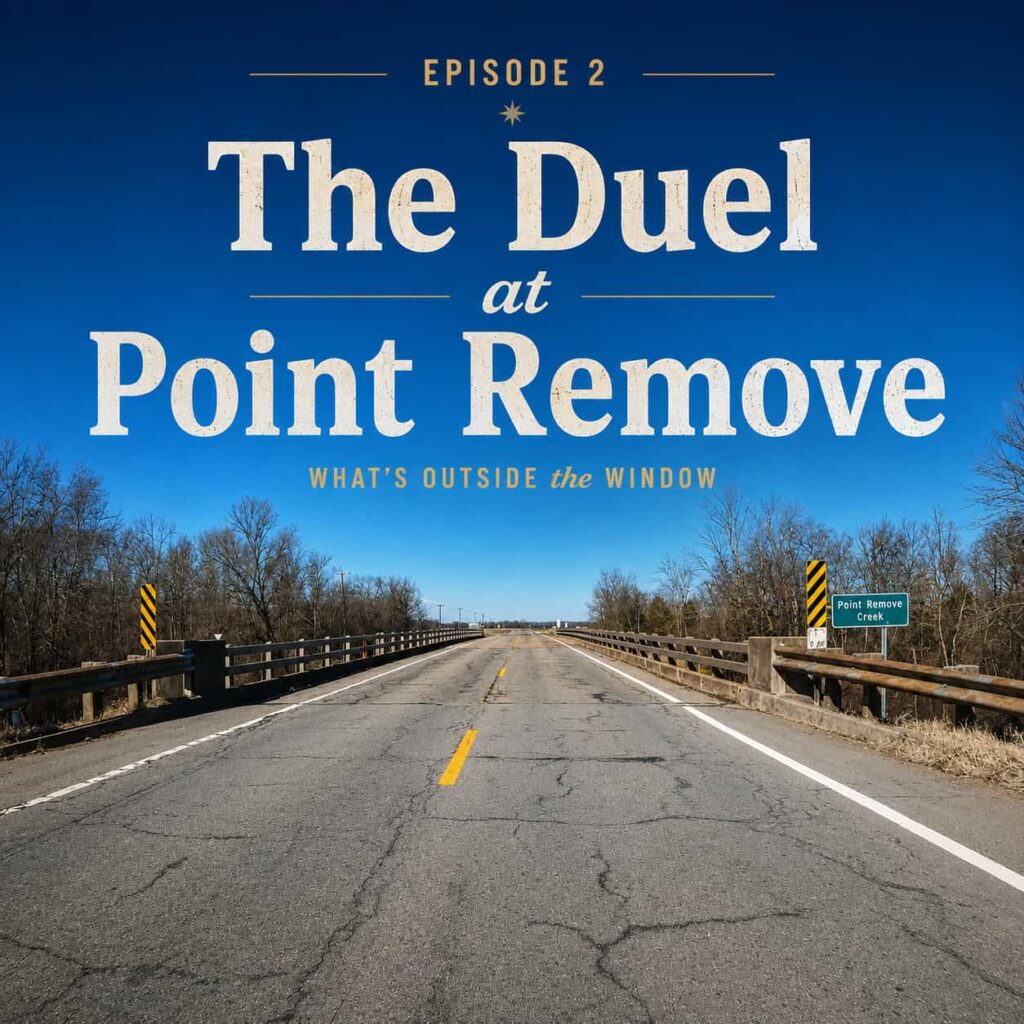
In this episode of What’s Outside the Window, we follow Point Remove Creek south from U.S. 64 into one of territorial Arkansas’s stranger political stories—a feud that sent two young politicians to a dueling ground in 1827 and helped set the stage for a fatal confrontation just weeks later.
In this episode
- Why Point Remove became a convenient place for an illegal duel
- The political feud between Henry Wharton Conway and Robert Crittenden
- Thomas Willoughby Newton and Ambrose H. Sevier’s roles in that feud
- The newspaper dispute that helped trigger the challenge
- Why Newton and Sevier crossed beyond Arkansas territorial jurisdiction
- The formal structure of their September 4, 1827 duel
- How Dr. Nimrod Menifee helped bring the confrontation to an end
- Menifee’s connection to the modern town along U.S. 64
- The Conway-Crittenden duel just 55 days later
- Conway’s fatal wound and death
- How Sevier’s political career changed after Conway’s death
- The later rise of Arkansas’s powerful political “Family”
- Point Remove’s later history, including Civil War fighting and eventual abandonment
- What remains of the landscape today
The accompanying RealRoads footage follows U.S. 64 through the Arkansas River Valley and across Point Remove Creek west of Morrilton—the modern highway crossing that leads into the story of what happened farther south near the Arkansas River nearly two centuries ago.
West of Morrilton, Arkansas, both U.S. 64 and Interstate 40 cross a quiet waterway called Point Remove Creek. Most travelers probably never give the name a second thought.
But follow that creek south toward the Arkansas River, and it leads into one of the stranger episodes of Arkansas territorial history.
On September 4, 1827, Thomas Willoughby Newton and Ambrose H. Sevier met at Point Remove to settle a political quarrel with pistols. Their dispute grew out of the increasingly bitter rivalry between 2 of the most powerful men in Arkansas Territory: Robert Crittenden and congressional delegate Henry Wharton Conway.
Point Remove offered a particularly useful setting. Arkansas Territory had already outlawed dueling, while the historic Point Remove area lay across the Cherokee boundary and outside territorial jurisdiction.
Newton and Sevier exchanged fire. Neither man was hit. According to surviving accounts, their companions—including Sevier’s surgeon, Dr. Nimrod Menifee—helped prevent the affair from continuing.
That might have made the whole episode little more than an unusual footnote.
Except 55 days later, Crittenden and Conway themselves met on a dueling ground.
This time, somebody didn’t miss.
In this episode of What’s Outside the Window?, we follow U.S. 64 through the Arkansas River Valley and uncover the political feud, territorial boundary, dueling culture, and unlikely cast of characters behind the Duel at Point Remove—and the fatal confrontation that followed it.
How Did a Duel Actually Work?
By the early 19th century, a formal duel was supposed to follow a set of rules rather than devolve into a spontaneous gunfight.
Each man brought a second—a trusted representative who handled most of the practical arrangements. The seconds chose or approved the ground, measured the distance between the duelists, agreed on the firing procedure, supervised the loading of the pistols, and made repeated attempts to resolve the dispute before anyone fired.
The exact rules varied from duel to duel, but many American affairs followed customs associated with the Code Duello, a widely circulated set of rules first formalized in Ireland in the late 18th century.
For pistol duels, the men were placed at an agreed distance—often somewhere around 10 to 12 paces or yards, depending on the circumstances. The seconds then agreed on the command or signal for firing. In some duels the men fired on a spoken command; in others they were permitted to fire within a short interval after the signal.
A “pace” was not a perfectly standardized unit, so we cannot turn that into an exact modern measurement. Roughly speaking, 10 paces probably meant something on the order of 25 to 30 feet.
The goal of a duel was not necessarily to kill the other man. In theory, it was about demonstrating that neither party would retreat from an insult or accusation. After one exchange of fire, the seconds could decide that honor had been satisfied and negotiate a reconciliation.
That appears to be what happened at Point Remove. Newton and Sevier fired, neither was hit, and the affair was brought to an end before it became deadly.
The customs could get surprisingly technical. A misfire could count as a shot. The seconds were expected to load the weapons fairly and in one another’s presence. Moving from the agreed position could violate the terms. And throughout the process, the seconds were supposed to keep looking for a way to end the dispute without further bloodshed.
In other words, dueling was violent—but it was also ritualized, highly structured, and governed by a strange combination of etiquette, reputation, and very real gunfire.

From the Biographical and Pictorial History of Arkansas by John Hallum, 1887 – Encyclopedia of Arkansas
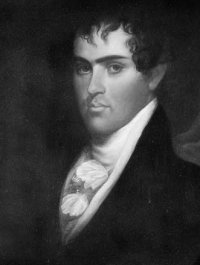
Portrait by L. E. Yandell, courtesy of the Arkansas State Archives – Encyclopedia of Arkansas.
Research trail
Sources & Further Reading
Research trail
Sources & Further Reading
- Encyclopedia of Arkansas — Point Remove (Conway County)
- Encyclopedia of Arkansas — Cherokee Boundary Line
- Encyclopedia of Arkansas — Thomas Willoughby Newton
- Encyclopedia of Arkansas — Conway-Crittenden Duel
- Encyclopedia of Arkansas — Dueling
- Encyclopedia of Arkansas — Nimrod P. Menifee
- Encyclopedia of Arkansas — The Family (Political Dynasty)
- U.S. House of Representatives — Henry Wharton Conway
- William F. Pope — Early Days in Arkansas (1895)
- Biographical and Pictorial History of Arkansas — Newton-Sevier and Conway-Crittenden Accounts (1890)
- Diana Sherwood — “The Code Duello in Arkansas,” Arkansas Historical Quarterly (1947)
- Matthew Byron — “Southerners are Very Territorial: Dueling and Territorial Politics in the Nineteenth Century South” (2016)
- Lonnie J. White — “The Election of 1827 and the Conway-Crittenden Duel,” Arkansas Historical Quarterly (1960)
- Laws of the Territory of Arkansas — Territorial Laws of 1819–1820 (published 1821)
- Arkansas State Archives — Nineteenth-Century Arkansas Dueling and the Territorial Anti-Dueling Law
- Treaty with the Cherokee, 1817 — Point Remove Boundary Description
- M. S. Ross — “Cadron: An Early Town That Failed,” Arkansas Historical Quarterly (1957)
- Arkansas Gazette — Contemporary Account of the Conway-Crittenden Duel, November 6, 1827
Transcript
Episode Transcript
Transcript
Episode Transcript
A quick note before you read: This transcript was created with a little help from AI, so you may occasionally run across a misheard word, misplaced punctuation mark, or something that came out a little differently than it was said. We’re a small operation, and we’d rather spend our time following the roads, digging into the history, and finding the stories hiding just outside the window. So if the robots wander into the wrong lane once in a while, bear with us—and enjoy the story.
---
Ric: You're listening to What's Outside the Window—the stories, history, and sometimes tragedy hiding in plain sight along America's highways. I'm Ric Wayland, and today we're traveling U.S. 64 through the Arkansas River Valley to Point Remove, where a political feud in 1827 sent two young men to a dueling ground with pistols and helped set the stage for an even deadlier confrontation just weeks later. So let's see what's outside the window.
We're traveling west on U.S. 64 through the Arkansas River Valley, about an hour northwest of Little Rock. A few miles west of Morrilton, the road crosses Point Remove Creek. Farther north, Interstate 40 crosses the same creek. It looks ordinary now—another waterway under another highway. But follow that creek south toward the Arkansas River, and you reach one of the stranger political stories in territorial Arkansas.
On September 4, 1827, Thomas Willoughby Newton and Ambrose H. Sevier came to Point Remove with pistols, seconds, surgeons, and a political grievance serious enough that they intended to settle it with gunfire. And that duel was only the beginning.
To understand why they chose Point Remove, we need to understand what this place actually was in 1827.
So, what was Point Remove?
Point Remove was more than just the name of a creek. The name predates Indian removal and is generally traced to the French word “remous,” an eddy or whirlpool. By the early 1800s, Point Remove was already a recognized place. A post office had been transferred there by 1824. But more importantly, Point Remove Creek marked a political boundary.
Under the 1817 treaty with the Cherokee, the boundary began near the mouth of Point Remove Creek on the Arkansas River. West of that line was Cherokee territory. That matters because Arkansas Territory had already outlawed dueling. So Point Remove offered a very practical advantage: cross the boundary, and Arkansas territorial law no longer reached you.
And to understand how a political argument could end with two men meeting at Point Remove with pistols, it helps to know what Arkansas Territory was like in 1827.
In 1827, Arkansas was still nine years away from statehood. Its political world was small, intensely personal, and factional. Newspapers and reputation mattered, and political disagreement could become personal very quickly.
By 1827, two men stood at the center of the territory's political feud: Henry Wharton Conway, Arkansas Territory's delegate to Congress, and Robert Crittenden, one of the most powerful political figures in early Arkansas. They had once been allies, but by 1827 they were bitter enemies, and their supporters split with them.
Among Conway's supporters was a young Ambrose H. Sevier, of the Seviers of Tennessee fame. On Crittenden's side was Thomas Willoughby Newton. Both were young and politically ambitious, and neither was inclined to ignore an insult.
So you've got two hot-headed young politicians backing opposing political factions. What could possibly push that all the way to gunfire?
Modern scholarship traces the immediate quarrel to an anonymous attack on Conway published in the Arkansas Gazette that was apparently written by Newton. At a Conway-faction barbecue, Sevier denounced the article and wanted to know who had written it. Newton was identified as the author, and he later acknowledged it. From there, the argument moved from newsprint toward a formal challenge.
Later Arkansas histories tell of a more theatrical version in which Sevier insulted Crittenden on a Little Rock street, and Newton confronted him directly. That version may preserve part of what happened, but the safer historical reconstruction is that the duel grew out of a larger Conway-Crittenden newspaper war and the identification of Newton as the author of an anti-Conway piece.
However the exact words were exchanged, Newton and Sevier ended up with a formal challenge between them. That was not unusual in the culture of the time, but it was illegal in Arkansas Territory.
So, on September 4, 1827, the men went to Point Remove—not the modern highway crossing, but farther south toward the Arkansas River, near the historic mouth of the creek, on the Cherokee side of the boundary.
They did not go alone.
Newton's second was George W. Jones. His surgeon was Dr. William P. Ryburn. A friend, Robert C. Oden, is also named in later accounts. Sevier's second was Wharton Rector. His surgeon was Dr. Nimrod Menifee.
This was not two angry men drawing guns in the street. A duel had structure. It had seconds, rules, medical attendance, and a very real expectation that someone might get hurt.
I'm not going to go into all the minutiae of how duels worked or the rules that governed them. I put a brief section about that on the episode page for anyone who's interested.
According to surviving later accounts, the ground was measured. The men were placed about ten paces apart. The pistols were prepared. The command was given.
Newton and Sevier fired.
Both missed, and no one was wounded.
That could have been the end of it. Apparently, it almost wasn't. Another exchange was contemplated. George W. Jones, Newton's second, later recalled the affair, stating that Dr. Nimrod Menifee, Sevier's surgeon, stepped in and helped bring the duel to an end before more shots were fired.
The men's companions intervened. The duel stopped, and Newton and Sevier eventually reconciled.
A brief note about Menifee: that name matters on this road. Coming west on U.S. 64 from Conway, we pass through the town of Menifee before reaching Morrilton. The town is named for the same Dr. Nimrod Menifee who was standing at Point Remove with Sevier that morning.
And he was no anti-dueling moralist. In fact, he was deeply familiar with dueling culture himself and later died after a violent knife-and-pistol duel in 1842.
So, if Menifee stepped between Newton and Sevier, he was not rejecting the whole practice. He was apparently deciding that the matter had gone far enough.
Menifee may have stopped the shooting at Point Remove. He did not stop the political feud behind it.
Newton and Sevier apparently managed to settle their personal quarrel, but the larger political feud was still very much alive, because the two men at the center of it were still very angry: Robert Crittenden and Henry Conway.
And 55 days later, they met for a duel of their own.
On October 29, Conway and Crittenden crossed into Mississippi to settle the feud themselves—again, outside normal Arkansas territorial jurisdiction. And once again, this wasn't some spontaneous shootout. They brought seconds, agreed on the ground and the distance, and followed the formal rules of the duel.
In fact, Conway's second was Wharton Rector, the same man who had stood beside Sevier at Point Remove 55 days earlier.
They lined up and fired.
Conway's shot grazed Crittenden's coat. Crittenden's shot hit Conway in the chest.
This time, the duel did not end without bloodshed. Conway survived the initial wound, but on November 9, 1827, he died.
And Conway's death didn't end the feud's consequences. It created a political vacancy and opened the door for one of the men from Point Remove.
Conway's death left Arkansas Territory's congressional seat vacant, and the man eventually elected to fill it was Ambrose Sevier—the same man who had stood at Point Remove only weeks earlier with a pistol in his hand.
Sevier went on to become one of Arkansas's first U.S. senators and a major figure in early state politics. Newton eventually served in Congress, too. And both names became permanent parts of Arkansas geography: Newton County and Sevier County.
Two men who once stood across a dueling ground from each other ended up with their names on the map.
A few things before we leave Point Remove.
First, the Family. Conway's political faction did not disappear with his death. His relatives and allies became part of the powerful Arkansas political network later known as the Family. Sevier became one of its major figures. The Point Remove duel did not create that system, but it happened right in the middle of the feud from which it emerged.
Point Remove, later in its history, would see armed conflict again. During the Civil War, Union and Confederate forces skirmished in the same general Point Remove country in September 1864. But that is another story.
After the Civil War, Point Remove never really developed into a lasting community. A post office operated in the area into the late 19th century, and a bridge was built there around 1893, but the place gradually faded as transportation shifted and newer crossings took over. By the early 20th century, the settlement was effectively abandoned.
From the 1930s through the late 1960s, the isolated area was used as Morrilton's city dump. Environmental cleanup and development of the McClellan-Kerr Arkansas River Navigation System eventually transformed the site, and today a small park occupies part of the old Point Remove landscape.
Today, U.S. 64 simply crosses Point Remove Creek west of Morrilton. I-40 crosses the same creek a short distance farther north. Most people pass over it without thinking twice.
But follow that creek south toward the Arkansas River, and the ordinary landscape opens into territorial Arkansas.
Somewhere near the historical mouth of Point Remove Creek, Newton and Sevier stood facing one another in September 1827. They fired. They both missed. Their friends stopped it. And 55 days later, the political feud behind their duel turned fatal.
That is what happened outside the window.
And that's our stop for today. You can find the sources for this episode, along with the RealRoads.tv video that brought us here, at whatsoutsidethewindow.com. If you enjoyed this episode, subscribe wherever you get your podcasts and come back as we keep looking beyond the pavement, the signs, and the exits for the stories hiding just outside the window.
I'm Ric Wayland. Thanks for coming along.
Listener notes
Join the Conversation
Share a thought, correction, local memory, or a story from the road. Your email address is never published.