
The Carrollton Bus Crash: What Happened Along I-71
Interstate 71 near Carrollton, Kentucky — May 14, 1988
The Carrollton Bus Crash: What Happened Along I-71
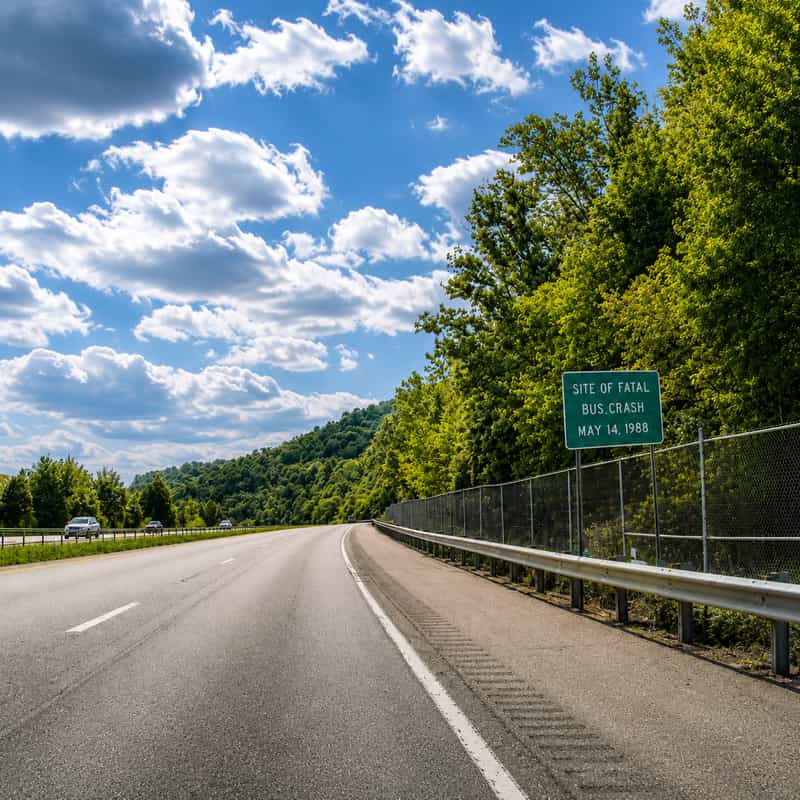
If you travel south on Interstate 71 through northern Kentucky, there is a small green sign near Carrollton marking the site of a fatal bus crash on May 14, 1988.
It is easy to pass without giving it much thought.
But behind that sign is the story of one of the deadliest impaired-driving crashes in American history.
On the night of May 14, 1988, a church activity bus carrying 67 people was returning to Radcliff, Kentucky, after a day at Kings Island near Cincinnati. Most of those aboard were children and teenagers.
In this episode of What’s Outside the Window, we stop—figuratively, at least—and look behind those few words.
In this episode
- The church group’s trip to Kings Island
- Larry Mahoney’s movements before the crash
- Weather, highway geometry, and John Pearman’s limited reaction time
- The collision and fuel-tank rupture
- The fire and evacuation through the rear of the bus
- The NTSB’s technical findings
- Why the impact itself was survivable
- The 27 fatalities and 40 survivors
- The criminal case against Mahoney
- The lives of several survivors in the decades since
- School-bus safety changes and recommendations
- The history of the Carrollton crash-site marker
- A look at the crash site as it appears from I-71 today
The accompanying RealRoads footage shows the southbound approach to the crash site as drivers see it today, including the gradual curve, slight uphill grade, and roadside marker.
The video also features “The Lights on Seventy One” by The Open Road Collective, a song written specifically about the Carrollton crash.
Sources
This episode relies primarily on the official investigation conducted by the National Transportation Safety Board, supplemented by contemporary reporting, trial coverage, survivor interviews, and later reporting on the memorial and long-term aftermath.
The complete source list appears below, including a direct link to the NTSB’s full technical report.
Where secondary accounts conflict with the NTSB’s technical findings, this episode generally follows the official investigative record.
Research trail
Sources & Further Reading
Research trail
Sources & Further Reading
Primary Investigation
-
NTSB — Final Highway Accident Report HAR-89/01
Pickup Truck/Church Activity Bus Head-on Collision and Fire, Interstate 71, Carrollton, Kentucky, May 14, 1988
Principal technical source for the crash reconstruction, weather, road geometry, vehicle speeds, BAC testing, bus construction, fuel-tank rupture, fire, evacuation, medical findings, probable cause, and safety recommendations.
NTSB Final Report HAR-89/01 (PDF) -
NTSB — Investigation DCA88MH004
Official investigation page, docket, report, and safety recommendations.
NTSB Carrollton Investigation Page -
NTSB — Wrong-Way Driving Special Investigation Report
Later NTSB treatment of Carrollton as a wrong-way-driving case; useful for Mahoney's lane position, speed, and wrong-way-driving context.
NTSB Wrong-Way Driving Report (PDF)
Contemporary Reporting
-
UPI — May 15, 1988
Early reporting on Mahoney, his background, and toxicology.
UPI — Drug test performed after fatal bus crash -
UPI — May 16, 1988
Early reporting as federal investigators began examining the crash.
UPI — Federal investigators begin Carrollton investigation -
Washington Post — May 16, 1988
Immediate aftermath, temporary morgue, and victim identification.
Washington Post — 27 killed in fiery church-bus crash -
Washington Post — May 17, 1988
Initial criminal charges and early investigative findings.
Washington Post — Murder charges filed -
UPI — November 22, 1989
Trial testimony about Mahoney's drinking, his activities before the crash, and friends taking his keys.
UPI — Friends took Mahoney's keys -
UPI — November 27, 1989
Testimony from truckers who encountered Mahoney's wrong-way pickup and then assisted at the burning bus.
UPI — Truckers testify in Mahoney trial -
Deseret News — November 29, 1989
Contemporary survivor testimony concerning the evacuation and conditions inside the bus.
Deseret News — Survivor testimony -
UPI — November 30, 1989
Additional survivor testimony concerning the collision, fire, and evacuation.
UPI — Carrollton survivors testify -
UPI — December 4, 1989
Kentucky State Police reconstruction testimony.
UPI — Police experts testify in Mahoney trial -
Los Angeles Times — December 15, 1989
Mahoney's testimony, his lack of memory of the collision, and his apology.
Los Angeles Times — Mahoney trial testimony -
UPI — December 18, 1989
Ford/Sheller-Globe litigation and the defense argument concerning the role of bus design in the fatalities.
UPI — Judge denies defense motion on Ford settlement -
UPI — December 21, 1989
Mahoney's convictions and his statement that he accepted the verdict and intended to warn others about drinking and driving.
UPI — Mahoney found guilty of manslaughter -
UPI — December 22, 1989
Jury recommendation of an effective 16-year sentence.
UPI — Jury gives Mahoney 16-year prison term -
Washington Post — December 23, 1989
Corroborates the detailed verdict breakdown and 16-year recommended sentence.
Washington Post — Jury recommends 16-year sentence -
Los Angeles Times — February 24, 1990
Useful for the complete conviction breakdown and the sentence formally imposed on Mahoney.
Los Angeles Times — Driver who killed 27 gets 16-year term
Survivors & Long-Term Aftermath
-
WCPO Cincinnati — From the Vault
Archival and retrospective reporting on victims, survivors, the church group, and the long-term impact of the crash.
WCPO — Carrollton Bus Crash: From the Vault -
WBKO — Quinton Higgins
Higgins on survival, advocacy, becoming a school-bus driver, forgiveness, and his hope that Mahoney might speak publicly about impaired driving.
WBKO — Quinton Higgins speaks to bus drivers -
WLKY — Quinton Higgins
Additional survivor account and Higgins's public outreach to students.
WLKY — Carrollton survivor speaks to students -
Lexington Herald-Leader — Jason Booher
Booher's escape, the loss of his best friend, his career in education, and later advocacy.
Lexington Herald-Leader — Jason Booher retrospective -
School Transportation News — Survivor Retrospective
Long-term recovery and survivor accounts, including Ciaran Madden.
STN — Carrollton crash: continuing to heal -
WAVE 3 — Ciaran Madden
Madden's public account of the crash, her recovery, and later advocacy.
WAVE 3 — Two decades later, survivor fights for change -
Associated Press / JEMS — 25th Anniversary
Particularly useful for Christy and Wayne Cox, survivor experiences, Mahoney's release, forgiveness, and long-term aftermath.
JEMS/AP — Survivors mark 25th anniversary
Memorial & Marker History
-
RoundAbout Madison — “Lasting Impact”
Retrospective account of the highway marker, motorists stopping at the crash site, former Carroll County Judge-Executive Harold “Shorty” Tomlinson's attempted removal of the marker, and objections from victims' families.
RoundAbout Madison — Lasting Impact -
WAVE 3 — 2003 Sign Removal
Contemporary reporting on the temporary removal of the crash-site signs during I-71 sign replacement and the debate over whether they should be restored.
WAVE 3 — Signs marking crash site removed -
KentuckyRoads.com — Marker Replacement
Secondary corroboration of the temporary removal and the change from “Carrollton bus crash” to the more neutral “fatal bus crash” wording.
KentuckyRoads — Fatal bus crash signs temporarily removed
Related Safety Context
-
NTSB — 2019 School Bus Fire Report
Later technical context on school-bus fire safety, emergency egress, and the regulatory legacy of earlier bus fires including Carrollton.
NTSB 2019 School Bus Fire Report (PDF) -
FHWA — Cable Median Barrier Research
General context for modern median cable-barrier programs. Used only to explain the purpose of the barrier visible today, not as evidence that Carrollton directly caused its installation.
FHWA — Cable Median Barrier Research
Transcript
Episode Transcript
Transcript
Episode Transcript
A quick note before you read: This transcript was created with a little help from AI, so you may occasionally run across a misheard word, misplaced punctuation mark, or something that came out a little differently than it was said. We’re a small operation, and we’d rather spend our time following the roads, digging into the history, and finding the stories hiding just outside the window. So if the robots wander into the wrong lane once in a while, bear with us—and enjoy the story.
---
You're listening to What's Outside the Window, the stories, history, and sometimes tragedy hiding in plain sight along America's highways. I'm Rick Wayland.
Today we're stopping along Interstate 71 to take a closer look at one of the deadliest drunk driving accidents in American history: the Carrollton bus crash of 1988.
Before we begin, a warning about the subject matter in this episode. The story involves the deaths of children and adults in a highway collision and fire. We will discuss the circumstances of the crash, the evacuation of the bus, injuries, smoke inhalation, and the identification of victims. We will avoid unnecessary graphic detail, but some of the material may still be difficult to hear.
Further, this episode is based primarily on the official investigation conducted by the National Transportation Safety Board, supported by contemporary news and trial reporting, survivor accounts, and later retrospective coverage. Where investigators could not establish something with certainty, we will try to make that clear. There are also details about the Carrollton crash that have been repeated for decades but which either cannot be confirmed or differ between sources. When that happens, we generally defer to the official investigative record. A complete list of sources, including a direct link to the NTSB's final technical report, is available on the episode page.
Finally, this is a historical account. It cannot represent the experience of every survivor or every family affected by what happened at Carrollton. Some have spoken publicly about the crash for decades; others have not. Nothing in this episode is intended to speak for them.
I have been traveling Interstate 71 for about as long as I can remember. Before I was old enough to drive it myself, I was riding along it. And since I started driving, I have traveled this highway so many times that quite a bit of it has become muscle memory. There are roads like that. You recognize exits almost without reading the signs. You know where the traffic usually gets heavy. You know where the road climbs, where it curves, where the lanes change, and there are landmarks that eventually become part of the drive.
One of those landmarks for me has always been a sign near Carrollton, Kentucky. It marks the site of a fatal bus crash. I remember seeing it for years before I really knew what had happened there. Obviously, the sign tells you somebody died. But fatal crashes happen on interstate highways every day somewhere in this country. Most don't get permanent highway signs. So before I even knew the story, I remember thinking, whatever happened here must have been bad. Years ago, curiosity finally got the better of me, and I looked it up. Not in any real depth, but I learned the broad outline: church bus, drunk driver, fire, 27 people dead, and then I moved on. But the story stayed attached to that sign in my memory. More accurately, I suppose, the sign stayed attached to the story.
Recently, while traveling through Ohio and thinking about what this podcast could be, I started thinking about possible episodes. And this one was almost immediate. That sign near Carrollton had been tucked away in my memory for years. And once I started thinking about What's Outside the Window, it more or less screamed, "Story number one." Because this is exactly what this show is supposed to be about: something you pass at highway speed, something that may be familiar enough that you barely notice it anymore, something that gives you only a few words of explanation, and behind those few words is an entire story.
On the night of May 14, 1988, 67 people were traveling south on Interstate 71 aboard a church activity bus. Most of them were children and teenagers. They had spent a day at Kings Island near Cincinnati. They were going home. Twenty-seven of them never got there.
May 14, 1988, was a Saturday. Members of the First Assembly of God in Radcliff, Kentucky, had traveled north for a day at Kings Island. For the young people aboard the bus, this was essentially what it sounds like: a church youth trip to an amusement park. Roller coasters, rides, food, friends, a long day away from home. By evening, the important part of the trip was over. The group boarded the church bus for the drive back to Radcliff. There were 67 human beings aboard: 66 passengers and the driver.
That distinction is worth making because the bus is sometimes described as though it had been dangerously overloaded. It was not. The vehicle was rated as a 66-passenger school bus and was carrying 66 passengers plus its driver. Overcrowding was not identified as a cause of the disaster. At the wheel was John Pearman. The group left the Cincinnati area and headed south on Interstate 71 towards Louisville. By the time they reached Carroll County, it was dark. Some of the passengers were talking, some were resting, some were asleep. There was no reason for anyone aboard that bus to believe the final part of the trip would be remarkable in any way. They were simply going home.
Not far away was 35-year-old Larry Mahoney. Mahoney was not an unfamiliar traveler passing through northern Kentucky; he lived in the nearby Worthville area of Owen County, only a short distance from Carrollton. This was his part of Kentucky. We do not know how frequently he drove this particular stretch of Interstate 71, and there is no reason to claim he knew every interchange intimately. But he was not a tourist who had become confused on an unfamiliar highway hundreds of miles from home. Mahoney had been drinking heavily.
A blood sample taken approximately an hour and a half after the crash measured his blood alcohol concentration at 0.26%. The NTSB estimated that his level at the time of the collision had probably been somewhere around 0.28%, possibly higher. At the time, Kentucky used a blood alcohol concentration of 0.10% as the presumptive threshold for intoxication. So this was not someone hovering around the legal boundary. Mahoney’s measured level was more than two and a half times that threshold. He was profoundly intoxicated, and his movements on Interstate 71 that night were erratic.
The story is sometimes simplified into Mahoney taking the wrong entrance ramp and driving north in the southbound lanes until he struck the bus. Investigators were never able to establish that simple sequence. At one point before the crash, a motorist observed Mahoney traveling north in the proper northbound lanes. Mahoney then crossed the grassy median. He began traveling south in the southbound lanes, now going the correct direction, but was reportedly tailgating, weaving, flashing his high beams, and driving erratically. The witnesses eventually got away from him and exited near Carrollton. At some point after that, Mahoney changed direction again. Whether he crossed the median another time or exited and re-entered the interstate incorrectly was never conclusively established. But by approximately 10:55 that night, Larry Mahoney was traveling north in the southbound lanes of Interstate 71 toward the church bus.
This is one place where the road itself is worth seeing. In the accompanying RealRoads.tv video, we are traveling south on Interstate 71 through the crash site just as an ordinary traffic does today. The roadway approaches the location on a modest uphill grade while coming out of a longer curve to the right. Neither feature is particularly dramatic. This is not some dangerous mountain pass. There is no hairpin turn. There is nothing about this section of Interstate 71 that would normally make a driver nervous. But at night, road geometry and sight distance matter. And the NTSB tested visibility around the curve as part of its investigation.
Investigators found that the sight distance in the area was limited to roughly 400 to 500 feet. There were also no adverse weather conditions to complicate things further. At approximately 10:50 that night, about five minutes before the crash, weather observations from Louisville reported clear skies, seven miles of visibility, a temperature of about 68 degrees, and only a light wind. No snow, no fog, no rainstorm. Weather was not the explanation. Nor was this a case of the bus driver recklessly flying down the interstate. The posted speed limit at this location was 65 miles per hour. Investigators estimated the bus at roughly 54 miles per hour immediately before the collision. Mahoney’s pickup was estimated at between 52 and 61 miles per hour. Neither vehicle was traveling at some extraordinary, modern interstate speed. The danger came from something much simpler: they were moving toward one another on the same side of a divided highway, and together, their closing speed may have approached 115 miles per hour.
John Pearman did not have a long period of time to understand what was happening. This is another detail worth considering when looking at the highway in the video. At night, seeing headlights somewhere ahead on a divided interstate does not immediately mean a vehicle is coming straight toward you. There is traffic on the other carriageway. There are ramps. There are curves. There are changes in elevation. Only as the geometry resolves itself does the impossible become obvious. Those headlights are not across the median; they are in your roadway.
Using the estimated vehicle speeds and the 400 to 500-foot visibility available around the curve, the NTSB calculated that Pearman had only about two and a half to three seconds to perceive what was happening, react, and attempt to avoid the pickup. That number comes directly from the NTSB’s reconstruction. Pearman responded. He braked. He steered left in an attempt to avoid Mahoney. But nothing worked. Investigators specifically concluded that Pearman’s actions were appropriate given the extremely short time available and that his driving performance was not a factor in causing the crash. That point matters. There was no finding that the church bus driver was distracted, impaired, recklessly speeding, or that some obvious evasive maneuver would have prevented what was coming. He was faced with a vehicle approaching from a direction in which no vehicle should ever appear, and he had less than three seconds. At approximately 10:55 PM, the pickup and the bus collided.
Mahoney's Toyota struck the right front portion of the bus in an offset head-on collision. As the pickup rotated during the collision sequence, it also struck another southbound passenger car traveling near the bus. The occupants of that car were not injured. Mahoney was seriously injured. Inside the bus, people were thrown from their seats. The front of the vehicle suffered substantial damage, but the passenger compartment did not simply collapse and kill the people inside. And according to medical findings reviewed during the investigation, none of the 27 people who ultimately died had sustained collision injuries that were themselves fatal. Everyone aboard the bus survived the initial impact, at least initially. That means the collision is not really the climax of this story. It is only the beginning of the disaster.
To understand what happened next, we need to spend a little time on the bus itself. It is often described simply as a 1977 Ford school bus. More precisely, it was built on a Ford B700 chassis with its school bus body manufactured by the Superior Division of Sheller-Globe. That distinction matters because conventional school buses of this type are assembled from components supplied by different manufacturers. Ford supplied the chassis and drivetrain; Superior built the body mounted on top of it. The date of manufacture also became extremely important. The Superior body was manufactured on March 23, 1977. Just a week later, on April 1, upgraded federal school bus safety standards took effect for newly manufactured buses. Those standards covered several aspects of school bus safety, including structural integrity, occupant protection, and fuel system performance. The Carrollton bus fell on the older side of that regulatory line. There was nothing illegal about that. It had been manufactured under the rules that applied to it at the time, and older buses did not suddenly become unlawful when newer standards took effect. But buses manufactured under the newer requirements had to meet standards this one had never been required to meet.
There is also an important nuance here. It is sometimes said that federal regulations after April 1, 1977, simply required every fuel tank to be surrounded by a puncture-proof cage. That is a gross oversimplification. The federal rule was principally a performance requirement intended to limit fuel leakage during specified crash conditions. Manufacturers could use protective structures and other engineering solutions to meet that requirement. The important point is simpler: the federal government had already recognized that post-crash fuel leakage posed a serious hazard for school buses, and this bus had been manufactured immediately before the newer standards applied.
The bus carried gasoline in a 60-gallon fuel tank mounted along the right side of the chassis. During the collision, components in the right front suspension and chassis area were driven backward. The fuel tank was punctured. Investigators believed that part of the damaged right front leaf spring assembly likely caused the puncture because its damaged end corresponded closely with an opening in the tank, but the NTSB stopped short of declaring that sequence proven beyond doubt. Physical evidence supported it as the likely explanation, but it did not conclusively prove which exact component made the hole. What was not in doubt was the result: gasoline escaped the tank and almost immediately passengers saw fire.
Some survivors told investigators they saw an orange glow and thick smoke within seconds of the collision. One passenger near the rear reported seeing fire trailing along the roadway while the bus was still moving after impact. Investigators considered possible ignition sources. Electrical arcing might seem like the obvious explanation after a violent collision, but the NTSB did not ultimately consider the electrical system to be the most likely source. Instead, investigators considered sparks or heat generated by damaged metal scraping against the roadway as a more probable ignition mechanism. But whatever provided the spark, gasoline was burning, and the fire was concentrated toward the front right portion of the bus.
That location presented an immediate problem: the front service entrance, the door everybody normally uses to enter and leave the bus, was effectively lost as an escape route. The fire and collision damage were concentrated around that portion of the bus. Passengers therefore moved away from the front, toward the rear emergency door. Some had been asleep. Some were injured. Some were disoriented. Smoke was spreading through the interior of the bus. People were shouting, people were pushing, some climbed over the seats rather than trying to use the aisle, and the rear emergency exit had another problem.
The factory-installed rear seating arrangement partially obstructed the path to the rear emergency door. At the bottom, the usable passage between the rear bench seats was approximately 12 inches wide. At approximately seat-top height, it was around 15 inches. Twelve to 15 inches. That is not the width of the emergency door itself; it is the effective passage people had to negotiate to reach it because of the way the rear seats overlapped the opening. Now imagine dozens of people converging on that space. Some were teenagers, some were adults, some were injured, some were losing consciousness. Smoke was spreading through the interior of the bus. People were shouting, people were pushing. Some climbed over the seats rather than trying to use the aisle. And the rear emergency exit had another problem. The factory-installed rear seating arrangement partially obstructed the path to the rear emergency door.
Professional rescuers were not standing beside the highway when the bus caught fire. The first people available to help were the people already there—survivors, fellow motorists, truck drivers, people who happened to be traveling Interstate 71 that night and suddenly found themselves looking at a burning bus full of children. Several stopped. They went toward the fire. They began pulling people through the rear door. Among those motorists were truck drivers who had encountered Mahoney's pickup traveling the wrong direction shortly before the collision. One attempted to use his CB radio after the crash.
This is another part of the story that makes more sense when we remember the year. A driver who saw a wrong-way vehicle could not simply assume there was a mobile telephone sitting on a console ready to dial 911. Cell phones existed, but ordinary motorists generally did not have them. A driver might have a CB radio. Otherwise, reporting a dangerous vehicle could require finding an exit and locating a telephone. Several motorists saw Mahoney driving dangerously that night. There is no evidence we have found that anyone successfully got a warning to police before the collision. And the final wrong-way portion of his drive appears to have unfolded rather quickly.
Fire departments and ambulances were coming, but the critical evacuation had already begun before professional responders reached the bus. Survivors and passing motorists performed most of the immediate rescue work. By the time fire crews arrived, the fire had progressed substantially. The important point here is not to speculate about whether some hypothetical faster response could have changed the outcome. The NTSB did not identify emergency response time as a contributing cause of the fatalities. Its findings focused instead on the fuel tank puncture and resulting fire, restricted access to the rear exit, and the flammability of the seat cushion materials.
Forty people escaped. Twenty-seven did not.
The accompanying RealRoads TV video includes a song by the Open Road Collective called "The Lights on 71." It was written specifically about this crash. The song tells the story at a very high level, and like any song, it uses poetic imagery rather than functioning as a historical record. But this seems like a good place to let it speak for a moment.
(Song snippet plays...)
The song says the story still rides the highway, and in a very real sense, it does. But to understand why 27 people died after surviving the collision itself, investigators had to look inside the bus. The medical examiner listed smoke inhalation as the cause of death for all 27 fatalities. That includes John Pearman, the bus driver. But that phrase should not be understood to mean that a single component of ordinary smoke exclusively killed everyone aboard. The NTSB survival analysis was more detailed. The interior of the bus became an environment of intense heat, dense smoke, soot, and toxic combustion products.
The seats contained polyurethane foam covered by a vinyl upholstery. When those materials burn, they can produce substantial heat and a complex mixture of gases and particulates. The NTSB specifically identified hydrogen chloride and heavy black soot as the likely contributors to inhalation injuries. Investigators also discussed hydrogen cyanide because polyurethane foam can produce it under certain burning conditions. But the NTSB did not establish cyanide poisoning as a cause of the Carrollton deaths. That distinction matters. A supportable conclusion is that heat, smoke, soot, and toxic products of combustion created a rapidly worsening environment and contributed to the occupants becoming incapacitated. A person did not have to be physically reached by flame in order to become unable to escape. Smoke and toxic combustion products could disorient them, then weaken them, then render them unconscious. Once someone stopped moving in that crowded rear passage, escape became even more difficult for everyone behind them.
John Pearman deserves a moment of his own. There are accounts of this story that describe him being killed or incapacitated immediately at the steering wheel. That is not what the medical evidence shows. Pearman survived the collision. Like the other 26 victims, the medical examiner attributed his death to smoke inhalation. Investigators found him further back inside the bus, not still sitting behind the steering wheel as other people claim. Whatever happened during those final minutes, he had left the driver's seat after impact. The NTSB found no fault with his operation of the bus. He had between 2.4 and 3 seconds to perceive the threat and react. He tried to avoid Mahoney's pickup. He just couldn't. He survived the crash Mahoney caused, and he died in the fire that followed.
Twenty-seven is the number most associated with Carrollton: 26 passengers and John Pearman. Twenty-four of those killed were young people, the youngest was 10 years old. Her name was Patty Nunnally. Numbers are useful because they tell us the scale of an event. They are also inadequate. For the families in Radcliff, this was not 27. It was a son, a daughter, a father, a friend, a person who had boarded a bus for Kings Island that morning and was supposed to come back that night. And this was 1988. There were no smartphones providing real-time information from the highway. There was no family group chat. There was no social media page refreshing every thirty seconds. Parents heard that something had happened. Then they had to find out if their child was among the people who had escaped. The fire had made identification of some victims extremely difficult. A temporary morgue was established at the Carrollton National Guard Armory, and families were asked for dental records of their children. There is very little useful embellishment that can be added to that fact. Parents who had expected to meet a returning amusement park bus were instead being asked for information that could identify their children's remains.
The NTSB arrived to answer questions much broader than whether Larry Mahoney had been drinking. That part was relatively clear. The Board's job was to determine why this particular collision had produced this particular outcome. Investigators examined the vehicles, the pavement, the highway, the fuel tank, the suspension, the fire, the emergency exits, the seating, the interior materials, passenger survival, toxicology, and Kentucky's impaired driving enforcement system. The final finding separated the cause of the collision from the causes of its severity. The NTSB determined that Mahoney's alcohol-impaired wrong-way driving caused the collision. It then identified three major factors contributing to the severity of the disaster: the punctured fuel tank and resulting fire, the partial obstruction of the rear emergency exit area by the rear bench seats, and the flammability of the materials used in the bus seat cushions. That distinction is important. Bus design did not cause Larry Mahoney to drive the wrong way while intoxicated. Seat cushions did not cause the crash. But the design and construction of the bus helped determine what happened after he hit it.
The NTSB ultimately issued 14 safety recommendations following Carrollton. They addressed multiple subjects: alcohol-impaired driving, state enforcement programs, bus operation, fuel system protection, emergency evacuation, interior materials, and the use of older school buses by churches and other organizations. Carrollton is sometimes credited with creating virtually every modern school bus safety requirement. That overstates its role. Federal school bus standards had been evolving for years before 1988. In fact, the manufacturing date of the Carrollton bus demonstrates that better than almost anything else. The bus was built only days before major new federal requirements took effect. So Carrollton did not suddenly teach the federal government that school buses needed to be safer. But it demonstrated in the worst possible way what could happen when an older vehicle built to previous standards remained in service. Later requirements expanded emergency exits on school buses. Kentucky adopted additional safety measures. And Carrollton became one of the primary cases cited in discussions of bus evacuation and post-crash fire. If you look at a modern school bus and see multiple emergency exits, roof hatches, improved fuel system performance, and stricter interior material standards, no single crash created all of those things. But Carrollton is part of that history.
Larry Mahoney survived. There is a bitter observation that often appears after drunk driving crashes: somehow, the drunk driver lives. It is not a medical rule; research does not show that intoxication reliably protects people from serious crash injuries. But the observation persists because there are cases where the impaired driver survives while innocent people do not. Carrollton became one of those cases. Mahoney was seriously injured in the smaller pickup, but he lived. He later testified that he had no memory of the collision itself. His memory resumed later in the hospital. He apologized to the families. At trial, the central question was not whether the crash had happened or whether Mahoney had been intoxicated. The legal dispute centered on the degree of criminal culpability and the defense's argument that characteristics of the bus contributed to the deaths after impact.
Mahoney had initially been charged with 27 counts of murder. The jury rejected murder. Instead, it convicted him of: 27 counts of second-degree manslaughter, 12 counts of first-degree assault, 27 counts of first-degree wanton endangerment, 14 counts of second-degree wanton endangerment, and driving under the influence. The jury recommended sentencing totaling hundreds of years on paper, but ordered them to run concurrently. The effective sentence was 16 years. Mahoney was released in 1999 after serving fewer than 10. At his sentencing, he told the jurors he accepted their verdict. He also said that after serving his time, he intended to warn others about the dangers of drinking and driving. In practice, Mahoney largely withdrew from public life. Some survivors have said publicly that they wished he had taken on that role. Their reasoning was straightforward: someone responsible for one of the deadliest impaired driving crashes in American history might have a uniquely powerful warning to give. He apparently chose not to become a public advocate. Some survivors forgave him. Others processed the aftermath in their own ways. There is no requirement to force them into a single collective reaction.
Forty people survived Carrollton. We know the stories of some of them because they chose, at some point, to speak publicly. That distinction matters. Forty people survived. We know the stories of some of them. Others have chosen privacy, and they are entitled to it. Survivors should not be required to become public advocates simply because something terrible happened to them as children. What we can say is that surviving Carrollton did not mean walking away from Interstate 71 and leaving the experience behind. Many of those people were children when they climbed, crawled, or were pulled through the back of that bus. They are adults now. Some became parents. Some became grandparents. They built careers, they married, they raised families, they lived ordinary lives after an extraordinarily abnormal night. And public accounts over nearly four decades make clear that, for at least some of them, May 14, 1988, is not simply an old event in a history book. It is something they still carry.
Forty people survived. Twenty-seven did not. That is the story hiding behind the sign on Interstate 71.
That's what's outside the window. That's our stop for today. You can find the sources for this episode, along with the RealRoads TV video we discussed, at whatsoutsidethewindow.com. If you found this episode worthwhile, subscribe wherever you get your podcasts, and come back as we keep looking past the pavement for the stories hiding just off the shoulder. I'm Rick Wayland. Thanks for coming along.
Listener notes
Join the Conversation
Share a thought, correction, local memory, or a story from the road. Your email address is never published.