
Florence Y’all
How a shopping mall, an interstate, and a $472 fix created one of Kentucky’s most recognizable roadside landmarks
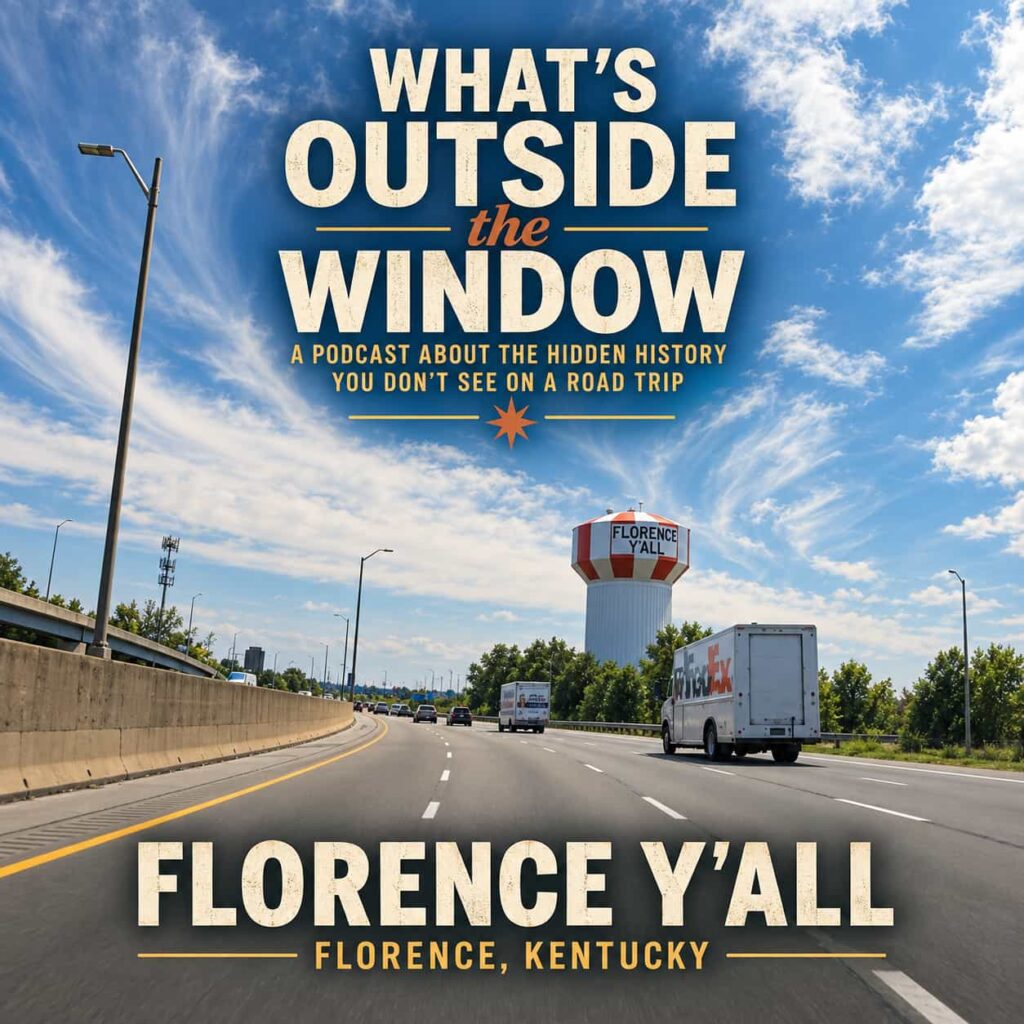
If you’ve spent much time traveling Interstate 71 or Interstate 75 through Northern Kentucky, there’s a good chance you already know the tower.
Bright red and white. Impossible to miss. And painted across the side in enormous letters:
FLORENCE Y’ALL
If you’re from the Cincinnati area—or you’ve driven this stretch often enough—you may even know the short version of the story behind it.
But the full story is bigger than a funny water tower.
It starts with a small Northern Kentucky crossroads town transformed by the arrival of Interstate 75. It continues with developers, annexations, utilities, state politicians, a massive new shopping mall, and a municipal water tower positioned almost perfectly beside the highway.
Originally, that tower didn’t say Florence Y’all.
It said FLORENCE MALL.
There was just one problem: the mall wasn’t open yet, and Kentucky highway officials objected to the enormous commercial message facing the interstate.
Florence needed a solution.
Rather than repaint the entire tower, Mayor C.M. “Hop” Ewing and city officials found a much cheaper answer. By altering the letter M and adding an apostrophe, MALL became Y’ALL.
The reported cost?
$472.
What was intended as a practical workaround became something nobody planned: a local landmark, a civic identity, and eventually one of the most recognizable roadside sights in Northern Kentucky.
And the timing of this episode is especially fitting.
Florence Mall officially opened on September 22, 1976. Fifty years later, the mall is still there, although its future as a traditional enclosed shopping center is uncertain.
Meanwhile, the supposedly temporary words painted on the water tower are still standing over the interstate.
In this episode
- How Florence grew from a small crossroads community into one of Northern Kentucky’s major commercial centers
- The role Interstate 75 played in reshaping Florence
- Why the Hopeful Heights annexation mattered
- How developers and local officials worked to bring a major regional shopping mall to Florence
- Why a municipal water tower ended up advertising Florence Mall
- The 1974 highway objection to the original FLORENCE MALL lettering
- Mayor C.M. “Hop” Ewing and the famous M-to-Y solution
- The reported $472 alteration that created FLORENCE Y’ALL
- Florence Mall’s phased opening and its September 22, 1976 grand opening
- How the mall helped drive decades of development along the I-71/I-75 corridor
- How “Florence Y’all” grew from an improvised fix into part of the city’s identity
- The mall’s uncertain future as it reaches its 50th anniversary
- Why the temporary solution may ultimately prove more enduring than the thing it was originally supposed to advertise
The full RealRoads.tv drive associated with this episode follows the southbound I-71/I-75 corridor through Florence, where both Interstate routes share the same pavement.
We’ve also included a short northbound clip offering a closer look at the Florence Y’all water tower from the opposite direction.
Sometimes what’s outside the window is a battlefield, a disaster site, or a forgotten piece of history.
And sometimes it’s a million-gallon water tower carrying a joke that accidentally became permanent.
That Tower Says Y’all!
Others get there by accident.
The Florence Y’all water tower belongs firmly in the second category.
What began as a straightforward advertising message beside Interstate 75 turned into one of Northern Kentucky’s most recognizable roadside sights after a remarkably simple change transformed “Florence Mall” into “Florence Y’all.”
That odd little twist of highway history inspired The Open Road Collective to write “That Tower Says Y’all,” an original song celebrating the tower, the story behind it, and the unmistakable personality it has picked up along the way.
Consider it a musical roadside stop to go with the episode.
Give it a listen below — and next time you’re rolling through Florence, try not to look up and read the tower in rhythm.
See the tower from the northbound approach.
This short northbound clip shows the approach to the Florence Y’all water tower from the opposite direction, including a close-up of the famous lettering. Through Florence, I-71 and I-75 share the same roadway.
The tower and one of the people behind the story.
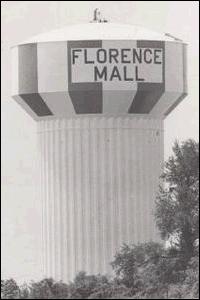
CC0 / public domain dedication via Wikimedia Commons.
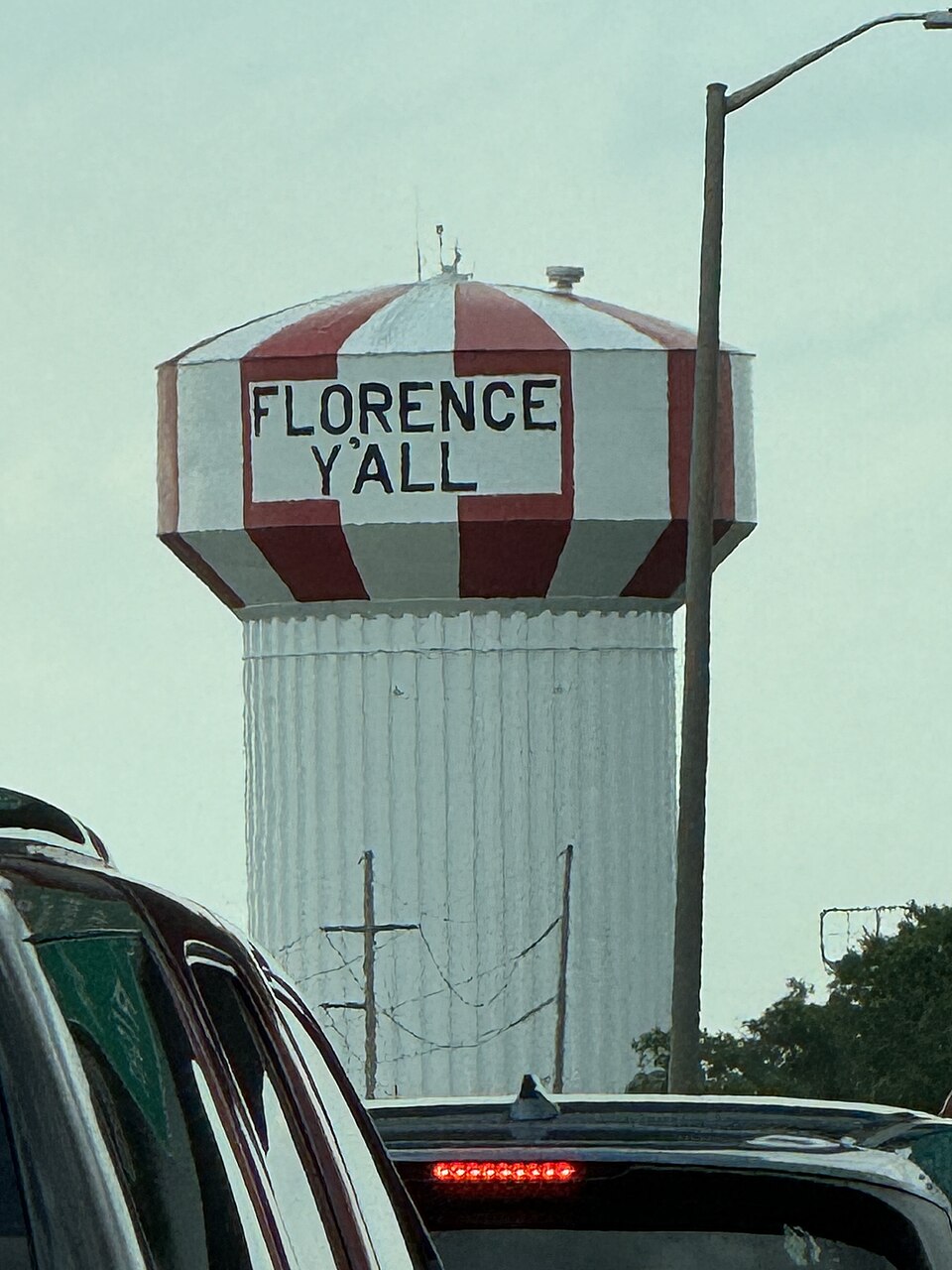
Photo: Sarah Stierch. CC0 / public domain dedication via Wikimedia Commons.
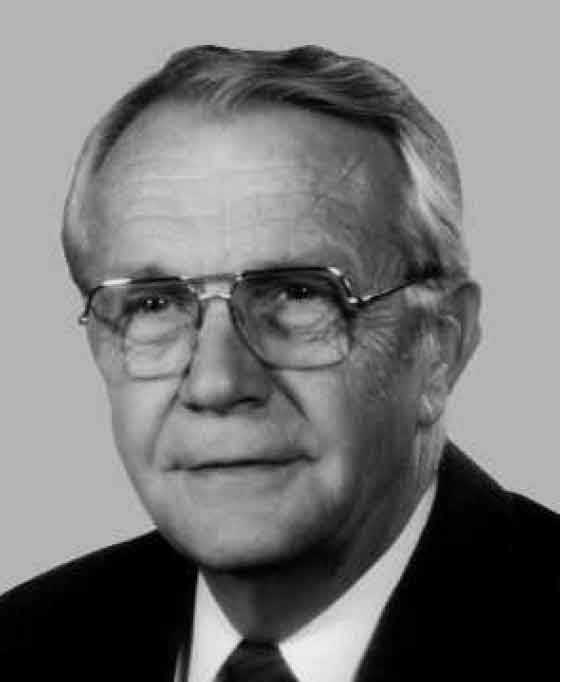
Official U.S. Congressional portrait. Public domain.
Florence Y’all Water Tower
The Florence Y’all water tower stands between Florence Mall and the shared I-71/I-75 corridor in Florence, Kentucky.
Research trail
Sources & Further Reading
Research trail
Sources & Further Reading
-
City of Florence, Kentucky — History of Florence, Kentucky
Official city history covering Florence’s early development, the arrival of I-75, the Hopeful Heights annexation, Florence Mall development, and the origin of the Florence Y’all water tower. -
City of Florence — Florence Visitor Guide
City-produced history and background on Florence, the Florence Y’all water tower, and the community’s transportation and commercial development. -
Los Angeles Times — “A Part of Y’all,” February 2, 2006
Retrospective account of the water tower’s origin, the mall developers’ land arrangement, the Kentucky Bureau of Highways objection, and the inexpensive lettering change that created “Florence Y’all.” -
The Cincinnati Enquirer — “Tower Given Southern Accent,” August 16, 1974, p. 1
Contemporary reporting on the state highway objection to the original “FLORENCE MALL” lettering and the subsequent alteration of the tower. Available through historical newspaper archives and library microfilm collections. -
KET / PBS — Florence Y’all
Interviews and local-history material concerning Mayor C.M. “Hop” Ewing, the water tower lettering change, and the story’s later place in Florence civic identity. -
Kentucky Legislative Research Commission — Kentucky Outdoor Advertising Regulations
Kentucky regulations governing advertising devices along interstate and federal-aid highways, including the distinction between on-premise and off-premise advertising. -
Northern Kentucky Tribune — “Questions persist about Florence Mall, a once-vital retail center, about its viable future,” July 2026
Reporting on the mall’s condition and redevelopment questions as Florence Mall approaches its 50th anniversary.
Transcript
Episode Transcript
Transcript
Episode Transcript
================================================================================
WHAT'S OUTSIDE THE WINDOW: PODCAST TRANSCRIPT
Episode: The Florence Y'all Water Tower
Host: Ric Weyland (Ric)
================================================================================
[A Quick Note from Ric:
This transcript was whipped together with a little help from artificial
intelligence. As a one-man production and definitely not a 24/7 corporate media
empire, I occasionally let the robots do the typing so I can focus on telling the
stories. Please excuse any tiny robot hiccups along the way!]
--------------------------------------------------------------------------------
[INTRO MUSIC]
RIC: You're listening to What's Outside the Window: the stories, history, and sometimes tragedy hiding in plain sight along America's highways. I'm Ric Weyland.
Today, we're heading back to Northern Kentucky, just south of Cincinnati, where I-71 and Interstate 75 share the same pavement through Florence. And if you've ever driven this stretch more than a few times, you probably already know what we're stopping to see.
It's big, it's red and white, and in letters you can read from the interstate, it says: "FLORENCE Y'ALL."
Now, if you're from Northern Kentucky, Cincinnati, or really anywhere else around the region, there's a decent chance you already know at least the short version of this story. "Florence Y'all" is not exactly a secret. But the full story is a lot bigger than somebody changing a letter on a water tower. It involves a town transformed by the interstate, a shopping mall that was supposed to change Florence forever, a mayor named Hop, a little bit of highway bureaucracy, and one very cheap solution to a very visible problem.
So, let's see what's outside the window.
--------------------------------------------------------------------------------
RIC: Before we get to the water tower, though, we need to back up a little and talk about Florence itself, because Florence has basically always had a transportation story. Long before there was an I-75 and I-71—or frankly, anything resembling the Florence most of us know today—this area was known as Crossroads, which is about as subtle a name as you can get.
Roads met here, and people passed through here. Travelers heading between places like Cincinnati, Lexington, Louisville, and Maysville moved through this little settlement in Boone County. By the 1830s, the Covington-to-Lexington Turnpike helped make Florence the first stagecoach stop south of Covington. And when people stop somewhere, businesses show up: hotels, blacksmiths, places to eat, places to repair wagons, and places to spend money before getting back on the road.
So even then, Florence existed partly because of the traffic passing through it. And that becomes kind of a recurring theme here, because when transportation routes favored Florence, Florence grew; when they didn't, Florence slowed down. The railroad, for example, favored nearby Erlanger. That shifted some of the travel and commerce away. But then, more than a century later, another transportation route would come along, and this one would completely remake Florence.
By the middle of the 20th century, Northern Kentucky was changing fast. The airport that would eventually become Cincinnati/Northern Kentucky International was built nearby during World War II, with commercial service beginning a few years later. But Florence was still pretty small. In 1950, the population was only around 1,300 people.
And then the interstate showed up.
I-75 opened through Florence in the early 1960s, and the numbers after that are ridiculous. Like I said, Florence had about 1,300 people in 1950. By 1960, it had nearly 5,900. And by 1970, more than 11,000. So, in about twenty years, Florence grew to almost nine times its previous size. That is not normal, slow suburban growth; that's a place being transformed.
And a big part of that transformation was happening right alongside the road we're driving today: homes, businesses, industry, hotels, and restaurants—all of the things that make this stretch of I-71 and I-75 look like, well, a pretty typical American commercial corridor. But at the time, it was all brand new, and Florence wanted more of it.
There's one municipal detail here that sounds boring until you realize why it matters. In 1961, Florence annexed an area called Hopeful Heights. The annexation added about 500 people, but more importantly for our story, it put Florence in a better position to expand and provide services around the interstate. That becomes important a few years later because in 1968, developers came to Florence with an idea—and not a small one.
They wanted to build a major shopping center right along the highway: an enclosed regional mall. And in the late 1960s and '70s, that meant a lot more than just shopping. A new mall was a destination. It brought department stores, restaurants, traffic, jobs, and shoppers from all over the region. And for a growing suburb like Florence, landing one was a huge deal.
By the late 1960s, Florence wanted something bigger. Chelsea Development Company approached the city about water and sewer service for the proposed project. But a mall doesn't just happen because somebody buys some land and starts pouring concrete. They needed infrastructure, utilities, roads, and in particular, they needed better access between Kentucky Route 18 and US 42.
So Florence Mayor C.M. "Hop" Ewing, Boone County Judge-Executive Bruce Ferguson, developers, and other local officials started doing what local officials do when they need something expensive built: they went to Frankfort. And according to the City of Florence's own history, one of those meetings involved Lieutenant Governor Wendell Ford.
And the story gets wonderfully Kentucky here. Ford reportedly called a Sears executive and told him, essentially, that if Ford became governor, the road the mall needed would get built. Ford did, in fact, become governor, and as promised, the road got built.
Now, whether that phone call alone sealed the deal or not, the larger point is pretty clear: Florence wanted this mall, local leaders wanted this mall, developers wanted this mall, Sears wanted this mall, and a lot of public and private effort went into making sure the thing actually happened. Eventually, Sears' real estate development arm, Homart Development Company, took over the project, and by the early 1970s, Florence Mall was moving from idea to reality.
And that brings us finally to the water tower.
In 1974, Florence built a new one-million-gallon water tower beside the interstate. Pittsburgh-Des Moines Steel built the tank. It was painted in the red-and-white pattern we recognize today. And because this giant new shopping mall was coming right next door, the tower was painted with two very large words: "FLORENCE MALL."
Which, honestly, at the time at least, made perfect sense. Think about it: you've got thousands upon thousands of people driving every day on I-75, you've got a massive new regional shopping center going up, and you've got a giant water tower sitting right beside the highway. It's not a water tower; it's an advertising platform. In fact, later historical accounts say that the mall developers provided the tower site to the city with the expectation that the tower would advertise the mall. And from their perspective, what a great idea!
There was just one problem, though: the mall wasn't open.
In the summer of 1974, the Kentucky Bureau of Highways objected. Now, this part of the story gets simplified a lot. You'll often hear that the Highway Beautification Act made the tower illegal or something like that, and that's not entirely wrong, but it does leave out some nuance. Kentucky already had rules controlling commercial advertising along interstates at the time, and because Florence Mall wasn't actually operating yet, the giant "FLORENCE MALL" message did not fit neatly into the usual exception for an on-site business sign.
So, in other words, the state looked at this enormous message facing I-75 and said essentially, "No, you can't do that."
The exact 1974 enforcement letter doesn't seem to be available online, so I'm not going to pretend to know every legal sentence in it. But contemporary reporting is clear on one central point: the state objected because Florence was advertising a business that did not exist yet. And suddenly, Florence had a very large, very visible, and freshly painted problem.
So how do you fix a water tower?
Imagine you're Mayor Hop Ewing. The city has just spent lots of money putting up this enormous water tower, and the mall developers want their name on it. The state, however, says the name has to come off, and repainting the entire thing is not cheap.
According to later accounts, city officials discussed a few options: repaint it, cover it, throw some giant tarp over the lettering... None of those were particularly attractive. And then somebody noticed the obvious: the word was "MALL," and the first letter was an "M." If you painted over the outside legs of that "M," you could turn it into something that looked a lot like a "Y." Add an apostrophe, and suddenly, "FLORENCE MALL" becomes "FLORENCE Y'ALL."
That was it. That was the solution. Not a branding campaign, not a consultant, not a focus group, not six months of bureaucracy or meetings or anything like that—just, well, "What if we make the M a Y?"
And the reported cost to do it? $472.
W.T. Marx Company of Cincinnati handled the alteration. And on August 16, 1974, the Cincinnati Enquirer put the story on page one under the headline: "Tower Given Southern Accent," which, in my opinion, is a pretty good headline.
If you've heard this story before, you've probably heard about the napkin. According to the version passed down by Hop Ewing's family and repeated in later interviews, the idea came together over lunch at the Stringtown Restaurant. Ewing was supposedly sketching possibilities on a napkin when he realized the "M" could become a "Y."
Do we have that napkin? Of course not. Do we have a 1974 newspaper article saying, "Mayor invents famous slogan on restaurant napkin"? Again, no. So I'm not going to present that as sworn courtroom testimony, but it has been part of the Ewing family's retelling for years. And frankly, it sounds exactly like the kind of thing that happens in local government: a giant municipal problem gets solved over lunch with a pen and whatever paper happens to be at the table.
Now here's the part I love: according to the City of Florence's own history, "FLORENCE Y'ALL" was supposed to be temporary. Once the mall actually opened, the idea was that the tower could go back to saying "FLORENCE MALL," which of course makes sense. The problem wasn't supposed to last forever: the mall would open, the highway objection would go away, and the city would put the original wording back. Simple.
Except something happened in the meantime: people actually started to like the new "FLORENCE Y'ALL." The dumb little workaround was memorable—a lot more memorable, it turns out, than the words "FLORENCE MALL" would have ever been.
Meanwhile, the mall itself was finally starting to come alive. It didn't open all at once. Sears opened first in March of 1976. Pogue's followed a year later. And on September 22, 1976, Florence Mall held its official grand opening. That date matters for us because this episode is coming out in September of 2026, which means Florence Mall is turning 50 years old. Fifty!
When the mall opened, Florence was still in the middle of this huge transformation from a small Boone County community into the commercial center we recognize today. The mall became a regional shopping destination. Lots more development followed: Mall Road grew, Houston Road grew, the Turfway area grew—more hotels, restaurants, retail, and parking lots, all that familiar suburban stuff, and a lot of it clustered around the same interstate that had already changed Florence once before.
And the tower? The tower never went back. No "FLORENCE MALL" restoration, no removal of the apostrophe, no return to the original plan. The supposedly temporary version just stayed. And then it started spreading.
There was a Florence Y'all Festival, merch, replicas, promos... Eventually, the phrase became so connected to Florence that the city itself embraced it. And then, in 2020, Florence's professional minor league baseball team went all the way: the Florence Freedom became the Florence Y'alls. They even leaned into the water tower as part of their branding. At that point, any idea that "Florence Y'all" was just some accidental paint job from the 1970s was long gone. It was now the town's identity.
And this is where I think the story gets more interesting than the punchline. Because the original goal was to advertise Florence Mall; that was supposed to be the important thing. The mall, the huge development, the permanent symbol of Florence's future. The water tower was infrastructure, but the words were marketing, and the "Y'all" thing was basically a cheap fix to get the highway department off everybody's back.
But look at what happened: the mall succeeded, Florence grew, the commercial corridor exploded, and the thing people remember most is the workaround—not the developer, not the road project, not the shopping center slogan: the workaround.
Now jump ahead 50 years. Florence Mall is still open, but like a lot of traditional enclosed malls, it's not what it once was. Sears is gone, ownership has changed, vacancies have grown, and local officials have openly discussed the possibility that the property's future may eventually involve something other than a traditional enclosed shopping mall. That doesn't mean the mall is dead, because it isn't, but at 50 years old, its future is uncertain.
Which gives this entire story a pretty incredible bit of irony. Because remember: "FLORENCE MALL" was the permanent thing; "FLORENCE Y'ALL" was the temporary thing. And 50 years later, which one of those feels more permanent?
So when you're driving I-71 and I-75 through Florence today, that big red-and-white water tower is more than a goofy roadside landmark. It's sitting in the middle of a landscape built by transportation. Florence started as a crossroads; indeed, its name was Crossroads. Then the turnpike brought travelers. Later, the interstate brought a completely different kind of growth. That growth brought the mall. The mall helped bring the tower. The tower created a legal problem, and the legal problem created "FLORENCE Y'ALL." And all because someone figured out that changing an "M" into a "Y" was cheaper than repainting a million-gallon water tank.
There are places along America's highways where the history is obvious: battlefields, historic buildings, monuments. And then there are places like this: places where the history is hiding in something you've passed a hundred times. Maybe you've laughed at it, maybe you've pointed it out to somebody in the passenger seat, maybe you've driven by it so often that you don't even notice it anymore. But the next time you pass that tower, remember: it wasn't supposed to say "FLORENCE Y'ALL," and it definitely wasn't supposed to stay that way. But sometimes, the temporary fix ends up being the thing everybody remembers.
And that's our stop for today. You can find the sources for this episode, photos of the tower before and after the famous lettering change, a short northbound look at "Florence Y'all," and the full Real Roads TV drive at WhatsOutsideTheWindow.com.
If you enjoyed the episode, follow or subscribe wherever you're listening so you don't miss the next story hiding along America's highways. I'm Ric Weyland. Thanks again for listening, and I'll see you down the road.
[OUTRO MUSIC]
================================================================================
Listener notes
Join the Conversation
Share a thought, correction, local memory, or a story from the road. Your email address is never published.